Care Guide
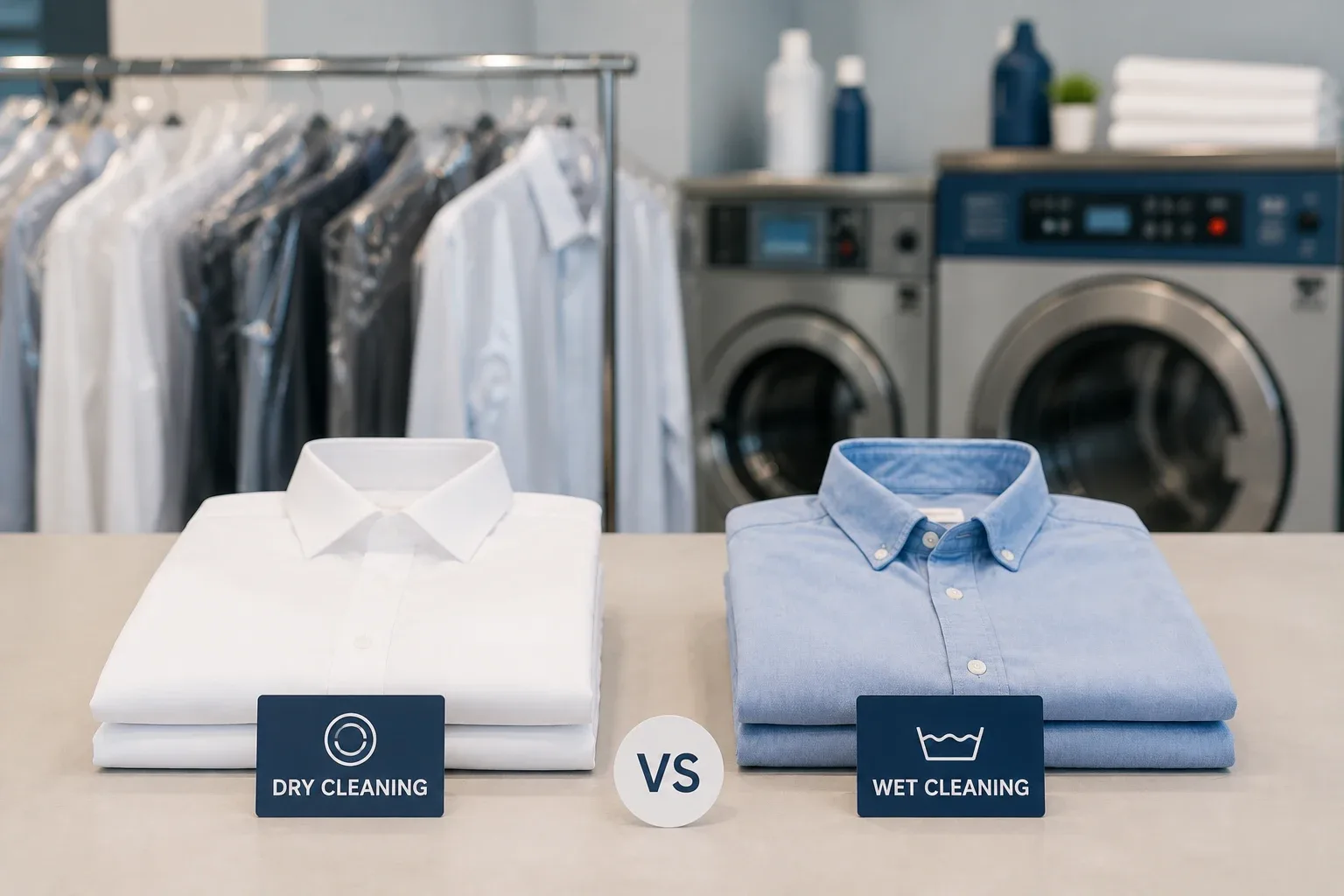
Dry Cleaning vs Wet Cleaning — What's the Difference?
Not every garment needs traditional dry cleaning. Wet cleaning can be gentler on fabrics and better for the environment.
You spill coffee on your shirt. Your wool coat smells like last night's dinner. A silk dress has makeup on the collar.
Do they all need the same kind of cleaning?
Not really.
Although people often use the term dry cleaning as a catch-all for professional garment care, dry cleaning and wet cleaning are two different processes. One relies on specialized cleaning solvents instead of water. The other uses water—but in a much more controlled way than a household washing machine ever could.
Choosing the right method isn't just about getting clothes clean. It can affect how long they last, how they fit after cleaning, and even how colors and fabrics hold up over time.
Why There Are Two Professional Cleaning Methods
At first glance, it seems like washing clothes should be simple. Add detergent, run a cycle, let everything dry.
That works for many everyday items. It doesn't work for everything hanging in your wardrobe.
Think about a tailored wool blazer. Or a silk evening dress with a delicate lining. Even something as ordinary as a pleated skirt can lose its shape if it's cleaned the wrong way.
Professional cleaners aren't simply removing dirt. They're trying to preserve the fabric, the stitching, the structure, and the finish of each garment. That's why different cleaning methods exist in the first place.
Some items respond better to solvents. Others clean more effectively with carefully controlled water.
What Exactly Is Dry Cleaning?
The name is a little misleading because nothing is actually "dry" about the cleaning process.
Instead of water, garments are cleaned inside specialized machines using liquid solvents. These solvents dissolve oils, grease, cosmetics, and other stains that don't mix well with water.
After the cleaning cycle, the solvent is filtered, recovered, and reused inside a closed system. The clothes then move through drying and finishing before they're pressed and inspected.
Most customers never see this part of the process. They simply drop off a garment and pick it up a day or two later.
Behind the scenes, though, quite a bit is happening.
A cleaner will usually inspect the item first, identify stains, check for loose buttons or damaged seams, read the care label, and decide whether the garment is even suitable for dry cleaning. If a stain needs special treatment, that's often done before the cleaning cycle begins rather than afterward.
That's one reason experienced cleaners can produce noticeably better results than automated self-service systems.
What Makes Dry Cleaning So Effective?
One word: oil.
Many of the stains people struggle with at home aren't water-based.
Foundation, lipstick, cooking oil, butter, sunscreen, body lotion, sebum, and grease all have one thing in common—they don't dissolve particularly well in water.
Cleaning solvents do a much better job.
That doesn't mean dry cleaning removes every stain. Permanent dye damage is still permanent. Burn marks won't disappear either.
But when it comes to oily contamination, solvent cleaning usually has the advantage.
Then What Is Wet Cleaning?
Here's where many people get confused.
Professional wet cleaning is not the same thing as putting clothes into a domestic washing machine.
The difference is mostly about control.
Commercial wet cleaning systems carefully manage water temperature, drum movement, detergent chemistry, moisture levels, drying time, and even humidity during finishing. The goal isn't simply to wash clothes—it's to avoid the shrinking, stretching, twisting, and distortion that often happen during home laundering.
Imagine washing a cashmere sweater by hand versus throwing it into a hot cotton cycle with towels and jeans.
Both involve water.
The outcome is rarely the same.
Professional wet cleaning follows the first approach, just with sophisticated equipment designed specifically for delicate textiles.
Can Water Really Be Safe for Delicate Clothes?
In many cases, yes.
Water itself isn't always the problem.
Heat is.
Aggressive spinning is.
Poor drying techniques are.
A wool sweater can shrink dramatically after an ordinary wash, not because water touched it, but because the fibers were exposed to excessive agitation and temperature changes.
Reduce those factors, and the result can be completely different.
This is why some garments labeled "Dry Clean Only" are successfully wet cleaned by experienced professionals. They understand how the fabric behaves, how stable the dyes are, and how much movement the garment can tolerate.
That doesn't mean every cleaner will make the same decision.
Two professionals may choose different methods for the same jacket, especially if it has decorative trims, glued interfacing, or complex construction.
Dry Cleaning vs Wet Cleaning: Which One Cleans Better?
It depends on what you're trying to remove.
If your jacket has accumulated skin oils around the collar after months of wear, dry cleaning often produces better results.
If a shirt is stained with sweat, coffee, or fruit juice, professional wet cleaning may have the advantage.
Real life isn't always that straightforward, though.
Many garments arrive with multiple stains. A blazer might have food grease on one sleeve, perspiration around the neck, and dust embedded throughout the fabric.
Professional cleaners rarely rely on just one technique.
They'll often pretreat individual stains before deciding which overall cleaning method gives the garment the best chance of coming out looking its best.
That's one reason stain removal can feel unpredictable to customers. Two stains that look almost identical may behave completely differently because their chemical makeup isn't the same.
Is One Method Gentler Than the Other?
People sometimes assume dry cleaning is always the safer choice.
It's not quite that simple.
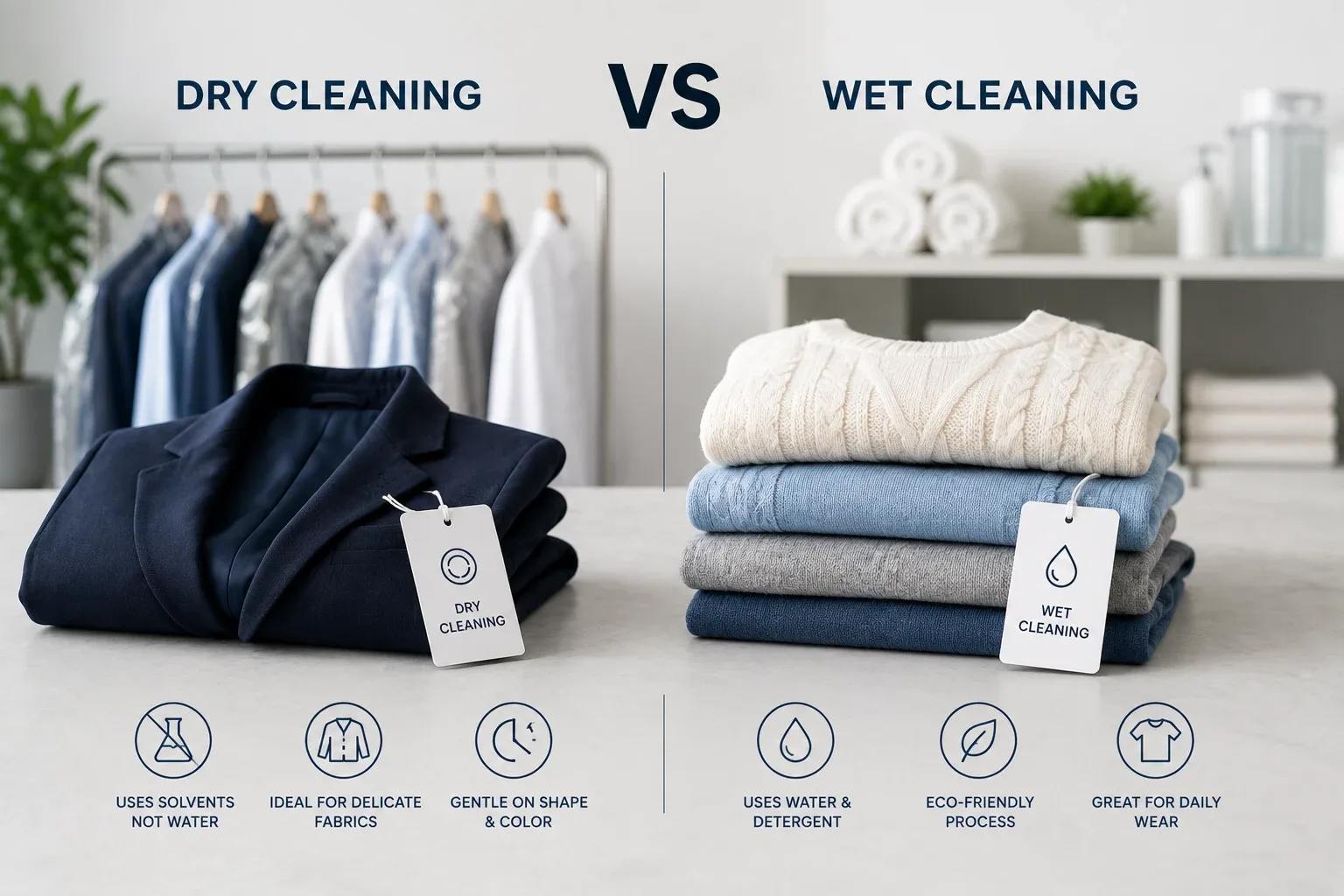
Dry cleaning generally helps structured garments keep their original shape because water isn't causing fibers to swell or shrink. That's especially valuable for tailored suits, wool coats, and jackets with multiple internal layers.
On the other hand, solvents aren't completely neutral. Over many cleaning cycles, certain decorative finishes, adhesives, or synthetic trims may gradually show signs of wear.
Professional wet cleaning avoids solvent exposure altogether, but introduces water into the equation. If the process isn't carefully controlled, fabrics can lose their shape surprisingly quickly.
That's why the cleaner's experience matters as much as the cleaning method itself.
A skilled technician doesn't ask, "Should I dry clean this?"
They ask, "What's the safest way to clean this particular garment?"
It's a subtle difference, but an important one.
Why Some Clothes Really Do Need Dry Cleaning
Take a well-made business suit.
From the outside, it looks like little more than wool fabric stitched together.
Inside, it's considerably more complicated.
A quality suit may contain canvas, shoulder padding, interfacing, multiple lining materials, hidden stitching, and carefully shaped construction that gives it its silhouette. Introducing water can affect each of those layers differently.
The same idea applies to formal dresses, structured blazers, and certain coats.
Sometimes it's not the fabric that's sensitive.
It's everything underneath it.
That's one reason care labels shouldn't be dismissed too quickly. Manufacturers usually test garments before deciding which instructions to print, even if those recommendations are occasionally more conservative than strictly necessary.
And Why Wet Cleaning Has Become More Popular
Professional wet cleaning has evolved a lot over the last couple of decades.
Older equipment simply couldn't offer the level of control available today.
Modern systems can adjust mechanical action so gently that garments barely move during parts of the wash cycle. Drying is equally controlled, helping fabrics retain their size and shape.
For cleaners, this has opened up new possibilities.
Items that once went automatically through solvent cleaning may now be safely cleaned using water-based methods instead.
That shift has another benefit.
Many customers actively look for cleaning options that reduce the use of traditional chemical solvents, particularly for clothing that doesn't genuinely require them.
Wet cleaning isn't replacing dry cleaning.
It's giving professionals another tool to choose from.
Does "Dry Clean Only" Always Mean Dry Clean Only?
This is one of the most misunderstood labels you'll find inside a piece of clothing.
Many people assume it means the garment will be ruined the moment it touches water. Sometimes that's true. Often, it isn't.
The label is the manufacturer's recommendation, based on how the item performed during testing. It's designed to reduce the risk of damage under normal consumer use—not to tell professional cleaners that only one cleaning method is possible.
There's an important distinction there.
An experienced cleaner may look at a "Dry Clean Only" blouse and decide that professional wet cleaning is perfectly safe. Another cleaner may choose solvents because the dye appears unstable or the construction looks fragile.
Neither decision is automatically right or wrong. They're based on experience, inspection, and sometimes a bit of caution.
For someone cleaning clothes at home, though, the safest approach is still to follow the care label. Professional cleaners have equipment and finishing techniques that simply aren't available in a standard laundry room.
What About the Environment?
The environmental side of garment care has changed quite a bit over the years.
For decades, many dry cleaners relied on perchloroethylene—usually shortened to "perc." It cleans extremely well, but concerns about its environmental and health impacts have led to tighter regulations in many countries.
As a result, many businesses have switched to alternatives such as hydrocarbon solvents, silicone-based systems, or other lower-impact technologies. Some have invested heavily in professional wet cleaning equipment instead.
That doesn't automatically make every wet cleaner the greener choice, though.
Water has to be heated. Machines use electricity. Drying garments consumes energy. Detergents still need to be manufactured and disposed of responsibly.
In other words, sustainability isn't determined by a single factor.
If environmental impact is high on your list of priorities, it's worth asking your cleaner what system they use rather than assuming based on the name alone.
How Much Does Dry Cleaning Cost?
There's no universal price list, which can be frustrating if you're comparing services online.
The cost usually depends on what you're bringing in.
A cotton shirt takes far less time to inspect, clean, and finish than a lined wool coat or a heavily embellished evening dress. That's reflected in the price.
Location matters too.
Someone searching for dry cleaning London will often find higher prices than someone living in a smaller town, simply because rent, wages, and operating costs are different.
Express turnaround, stain treatment, hand finishing, and specialist fabrics can all increase the final bill.
So when people compare dry cleaning prices, they're not always comparing like for like.
One cleaner may include stain treatment in the advertised price. Another may charge extra only if it's needed. A third might hand-finish every garment, while another relies almost entirely on machine pressing.
The cheapest quote isn't necessarily the best value if the garment is expensive to replace.
Looking for a Dry Cleaner? Here's What Actually Matters
Most people start with a quick search for dry cleaning near me.
That's perfectly reasonable. Convenience counts.
But once you've narrowed the list down, it's worth looking beyond distance.
A good cleaner should be willing to explain how they'll treat your garment, especially if it's valuable or delicate. They should inspect it before accepting it, point out any existing damage, and be honest about stains that may not come out completely.
That's a good sign.
Be slightly cautious if someone promises they'll remove every stain without even looking at the fabric. Textile care isn't that predictable.
Reviews can help too, but pay attention to what people praise. Comments about careful handling, consistency, and customer service often tell you more than a five-star rating on its own.
If you're trusting someone with a wedding dress, a tailored suit, or a cashmere coat, experience is worth paying for.
Common Situations People Don't Think About
Not every garment needs professional cleaning after every wear.
A wool overcoat that's been worn a handful of times during winter may simply need brushing and proper ventilation before it's ready to go back into the wardrobe. Cleaning it after every outing can actually shorten its lifespan.
The same goes for suits.
Many tailors recommend rotating suits, airing them out after use, and cleaning them only when they're visibly soiled or starting to retain odors. Frequent pressing and repeated cleaning—whether dry or wet—create wear over time.
On the other hand, some stains shouldn't wait.
Oil, wine, coffee, makeup, and food spills become more difficult to remove the longer they remain in the fabric. Even if you can't visit a cleaner immediately, blotting the stain gently and avoiding home remedies that could set it is usually the safer choice.
A quick internet tip can sometimes do more harm than the original spill.
So, Which One Should You Choose?
If there were a universal answer, professional cleaners wouldn't need two different systems.
Dry cleaning remains the better option for many structured garments, particularly those made from wool or designed to hold a precise shape. It's also highly effective against oily stains that water struggles to remove.
Professional wet cleaning shines in other situations. Advances in equipment have made it possible to clean many delicate fabrics safely using water, while often removing perspiration, odors, and water-based stains more effectively.
Most customers don't need to become textile experts.
They just need a cleaner who is.
The best professionals don't start with the cleaning machine—they start with the garment. They look at the fabric, the stitching, the lining, the stains, and the care label before deciding which method gives the clothing the best chance of coming back looking its best.
That's ultimately the difference that matters.
Final Thoughts
It's easy to think of dry cleaning and wet cleaning as competing methods, but they're really two solutions to the same problem.
One isn't replacing the other.
In fact, many professional cleaners use both every day because different garments demand different approaches.
The next time you're comparing dry cleaning prices or searching for dry cleaning near me, don't focus only on cost or convenience. Ask how your garment will be cleaned and why. A knowledgeable answer tells you far more about the quality of a cleaner than a discounted price ever will.
And if you're choosing between cleaners in a large city like London, where options are plentiful, expertise is often the deciding factor. The best dry cleaning London services aren't simply the ones with the lowest prices—they're the ones that know when not to use the same cleaning method for every item that comes through the door.